New Patients
Existing Patients
1151 Bethel Road, #301, Columbus, OH 43220
Call Today
5040 Palmetto St, Unit A, Columbus, OH 43228
New Patients
Existing Patients
Call Today

A confident smile changes how you feel and how others see you. When discoloration, chips, or small alignment issues stand between you and the look you want, veneers offer a minimally invasive way to refresh your front teeth while preserving much of your natural structure. This page explains how veneers work, who benefits most from them, and what to expect from the process — all in clear, patient-friendly language. At iSmile Dental Group, we approach cosmetic care with both artistry and clinical precision to help patients achieve natural-looking results.
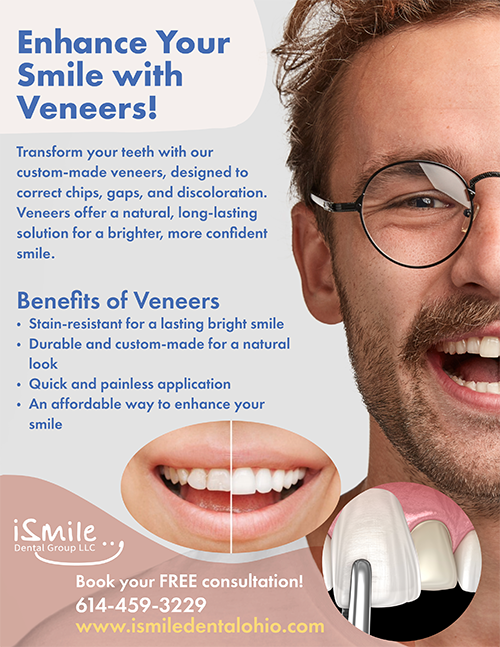
Veneers are thin, custom-made facings designed to cover the visible front surface of a tooth. Because they sit over the enamel rather than replacing the entire tooth, they can address a collection of aesthetic concerns — stains that do not respond to whitening, chips, worn edges, uneven shapes, and small gaps — in a single, unified treatment. That consolidated approach lets patients get consistent color, shape, and alignment across teeth that are most visible when they smile.
Compared with more extensive restorative options, veneers are conservative in the amount of tooth structure they require. Modern materials and bonding techniques are engineered to preserve enamel while creating a long-lasting aesthetic restoration. For many patients, veneers strike a balanced middle ground between noninvasive cosmetic measures and full restorative work, delivering dramatic cosmetic improvement without unnecessary intervention.
Another practical advantage is predictability. Because veneers are sculpted to specific dimensions and shade, patients and clinicians can plan the final appearance with a high degree of control. That predictability helps reduce surprises and makes it easier to achieve a natural result that complements facial features and overall smile proportions.
Porcelain remains the most commonly selected material for veneers because of its strength and its ability to mimic natural tooth enamel. High-quality dental porcelain transmits and reflects light in much the same way as real teeth, producing a lifelike translucency and depth. Porcelain is also stain-resistant, which helps the smile retain its appearance over time when proper care is maintained.
Some patients may be candidates for newer types of ceramic or composite resin veneers depending on the situation and clinical goals. Composite veneers can be completed directly in the mouth and are often used when a less invasive or faster solution is appropriate. For long-term aesthetic stability and strength, many clinicians still prefer lab-fabricated porcelain that is customized by skilled dental technicians.
The fabrication process blends digital technology and handcraft. Digital scans and photos guide shade selection and design, while skilled technicians refine contours and glaze to harmonize with the surrounding teeth. Whether produced in a specialized dental lab or milled on-site with CAD/CAM systems, the craftsmanship behind a well-made veneer is a major factor in achieving a seamless, natural appearance.

Veneers are ideal for patients whose primary concerns are appearance-related: discoloration that won’t respond to whitening, minor chips, wear, or slight gaps and misalignments. They work best on teeth with sufficient enamel and on patients who maintain good oral hygiene and regular dental care. A thorough clinical exam determines whether the underlying structures — gums, bite, and supporting teeth — are healthy enough to support veneers.
Patients with active decay, significant periodontal disease, or unmanaged bite problems will need to address those issues before veneers are considered. In cases of severe misalignment or complex bite concerns, orthodontic treatment may be recommended either before or instead of veneers to ensure stability and long-term success. Your clinician will outline the pros and cons of veneers compared with alternatives such as whitening, bonding, crowns, or orthodontics.
Realistic expectations are also important. Veneers can create stunning cosmetic improvements, but they aren’t reversible in cases where tooth structure is reduced. A careful discussion during the consultation helps patients decide if veneers align with their goals and whether the trade-offs — like future maintenance or eventual replacement — are acceptable.
The veneer journey typically begins with a comprehensive consultation. Your dentist evaluates oral health, checks bite relationships, and listens to your aesthetic goals. Diagnostic photos and digital impressions may be taken to plan the size, shape, and color of the veneers. During this visit you’ll review proposed changes and agree on a treatment plan that reflects both function and appearance.
To prepare a tooth for a veneer, a small amount of enamel is gently reshaped to create room for the new facing. The extent of preparation varies — in many cases it is minimal — and is guided by the desired final contour. After preparation, precise impressions or digital scans are captured and a shade is selected so the laboratory can fabricate restorations that blend naturally with adjacent teeth. Temporary coverings may be used while the permanent veneers are being crafted.
When the custom veneers return from the lab, your dentist will check fit, color, and comfort, making any minor refinements needed for a seamless match. The teeth are then cleaned, and a bonding protocol secures each veneer to its corresponding tooth. After placement, bite and margins are assessed and final adjustments are made to ensure comfort and function. A typical follow-up visit ensures that the veneers are performing well and that you’re satisfied with the result.
Veneers do not require special cleaning products — the same daily routine that protects natural teeth will help safeguard veneers. Regular brushing with a soft-bristled brush, flossing, and routine dental visits preserve both oral health and the appearance of restorations. Professional cleanings and periodic checkups allow the dental team to monitor margins, gum health, and overall function.
While porcelain is highly stain-resistant, minimizing heavy consumption of stain-causing substances and avoiding tobacco helps maintain optimal color. Patients should also avoid biting directly into very hard objects and be mindful of habits like nail-biting or opening packages with teeth, which can stress restorations. If you play contact sports or grind your teeth at night, custom nightguards or protective devices can reduce risk and prolong the life of veneers.
Over time, veneers may require maintenance or replacement, just like any long-term dental restoration. With good home care and regular professional oversight, many patients enjoy durable, natural-looking results for years. Your dental team will recommend a personalized schedule for checkups and any preventive measures to keep your smile looking its best.
Ready to learn whether veneers are the right choice for your smile? Contact iSmile Dental Group to schedule a consultation and discuss the options that best match your goals and oral health. Our team is happy to explain the process in detail and help you plan a tasteful, long-lasting outcome.

1151 Bethel Rd Suite, #301
Columbus, OH 43220
Existing Patients: (614) 459-3229
New Patients: (614) 328-8033
Determining if a veneer is suitable or a full-coverage crown is required depends on the extent of the tooth's defects and the remaining amount of healthy tooth structure. For teeth with imperfections that cannot be remedied with a teeth whitening procedure, dental veneers often provide the desired cosmetic improvements. However, a significantly undersized, misshapen, chipped, or darkly stained tooth usually requires a full coverage crown.
Porcelain veneers are fabricated from the highest grade of dental ceramics, which reflect light in much the same way as the enamel of natural teeth. In addition to this feature, dental porcelain is resistant to stains and discolorations, keeping your smile white and vibrant for years to come.
Porcelain veneers are ultra-thin customized facings that become strong and durable once bonded to the underlying teeth. With proper hygiene and routine dental care, veneers provide a cosmetic solution that not only looks and feels completely natural but is also long lasting.
However, just as harmful oral habits can affect your natural teeth, they can also cause damage to your veneers. To prevent chipping, cracking, or dislodging a veneer, avoid nail biting, chewing on hard candies, ice, pens, or pencils, and opening bottles or other objects with your teeth. Also, remember to protect your smile on the playing field by wearing a properly fitted sports mouthguard.
Tooth grinding or bruxism is another important consideration in care. If you clench or grind your teeth, you may need to wear a night guard to help protect your new smile or discuss other options with our office.
As versatile as they are beautiful, dental veneers can be applied to a single tooth in need of cosmetic improvement or multiple front teeth to dramatically improve the look of your smile. Whatever the case may be, dental veneers provide highly satisfying results to create a smile; you'll feel confident sharing with the world.
Among the many benefits offered by dental veneers is their ability to mask a range of imperfections at once. In addition to covering stains or discolorations on the front surface of a tooth, the size and shape of a veneer can also be customize to improve the tooth's contours and dimensions. At the same time veneers create a whiter and more vibrant smile; they can also lengthen or widen a tooth, close minor gaps, and address other minor alignment issues.
The two most common types of veneers are porcelain veneers, also known as porcelain laminates, and composite veneers. Although porcelain veneers are the most commonly offered option in care, composite veneers fabricated directly on the tooth can also achieve excellent results. You may have also heard the term no-prep veneer. It refers to a type of porcelain veneer that requires little to no preparation of the underlying dental enamel. At your consultation visit, we'll discuss your best options in care.
Once they're in place, your veneers are also easy to care for and maintain. Simply by brushing, flossing, and visiting our office for periodic checkups, you can successfully protect and preserve your new and beautiful smile.
Although certain procedures that are considered cosmetic may not be covered by dental insurance, veneers remain a worthwhile investment in your smile. Based on the unique considerations of each case, we develop treatment plans that consider specific dental needs, cosmetic goals, and budget. Our experienced and friendly office staff can address all your insurance questions and review various payment and financing options.
At the office of iSmile Dental Group, we value patient input and pay close attention to your treatment goals, concerns, and expectations in care. When it comes to cosmetic dentistry, we recognize that every smile is unique and never take a “one size fits all” approach to care. We utilize the most advanced diagnostic technology and treatment methods to assess your smile and to design your porcelain veneers for a precise fit and optimal aesthetics.
As experienced providers of care, we provide highly personalized treatment, combining state-of-the-art technology with an artistic touch to produce long-lasting and aesthetically pleasing results of care.