New Patients
Existing Patients
1151 Bethel Road, #301, Columbus, OH 43220
Call Today
5040 Palmetto St, Unit A, Columbus, OH 43228
New Patients
Existing Patients
Call Today

Missing teeth change more than your smile — they affect how you eat, speak, and feel about your appearance. Dental implants are designed to replace lost teeth with a solution that prioritizes durability, comfort, and natural function. At iSmile Dental Group, we focus on treatment plans that restore chewing efficiency and a confident smile while preserving the health of the surrounding teeth and jaw.

Unlike removable dentures or some bridgework, implants are anchored directly into the jawbone. That anchoring lets them support crowns, bridges, or full-arch restorations with stability that feels close to a natural tooth root. Because implants integrate with bone, they provide strong, predictable support that can withstand regular daily function without the slipping or shifting that can come with traditional prosthetics.
Your treatment plan is personalized to your needs. We consider your overall health, oral condition, aesthetic goals, and lifestyle to recommend the right approach — whether that is a single-tooth implant or a multi-tooth solution. Our objective is to rebuild a smile that looks natural and functions reliably for years to come.
At its core, a dental implant is a biocompatible post that replaces a missing tooth root. Once placed in the jaw, the implant bonds with the bone in a process called osseointegration. That fusion creates a stable foundation for a restoration — a crown, bridge, or denture — restoring the tooth’s appearance and performance without relying on neighboring teeth for support.
Successful implant care begins long before any procedure. Thorough diagnostics — including 3D imaging when needed — guide implant positioning and prosthetic design. This planning helps minimize surprises and supports efficient healing and long-term success. Your provider will explain each step, from initial evaluation through placement and final restoration, so you know what to expect at every stage.
While some patients may receive a temporary restoration the same day, others will wait for complete integration before placing the final prosthesis. The choice depends on individual circumstances and clinical judgment; our team prioritizes functional and aesthetic results that last.
Dental implants offer several advantages compared with traditional dentures or bridges. Because they replace the tooth root as well as the visible tooth, implants support better chewing performance and speech. They also help preserve jawbone volume by transmitting natural forces to the bone — a key factor in maintaining facial structure over time.
Implants can improve daily life in practical ways: no adhesives, no removable parts to manage, and no need to alter healthy neighboring teeth for support. Well-placed implants can also be easier to keep clean than some other prosthetic options, helping reduce long-term maintenance concerns when paired with routine dental care.
When placed with careful planning and routine follow-up, implants have a strong track record of stability and patient satisfaction. Their ability to preserve surrounding anatomy and provide consistent function makes them a durable choice for many people with missing teeth. In short, implants are a restorative option that supports both oral health and quality of life.

For one missing tooth, a single implant topped with a custom crown restores appearance and function without altering adjacent teeth. This approach replaces the root and the visible tooth, providing a discreet, long-term solution that integrates into your bite naturally.
When multiple adjacent teeth are missing, an implant-supported bridge can replace several teeth while sparing neighboring healthy teeth from being prepared. Strategically placed implants support the bridge, preserving bone and delivering stable chewing performance across the span.
For people missing most or all teeth, a fixed full-arch restoration supported by several implants offers a non-removable solution that mimics natural dentition. This option restores a wide range of function and eliminates the daily removal and adhesives associated with traditional dentures.
Overdentures that clip or snap onto implants combine the security of implants with the ease of a removable prosthesis. These restorations increase retention and comfort while still allowing the denture to be removed for cleaning, if desired.
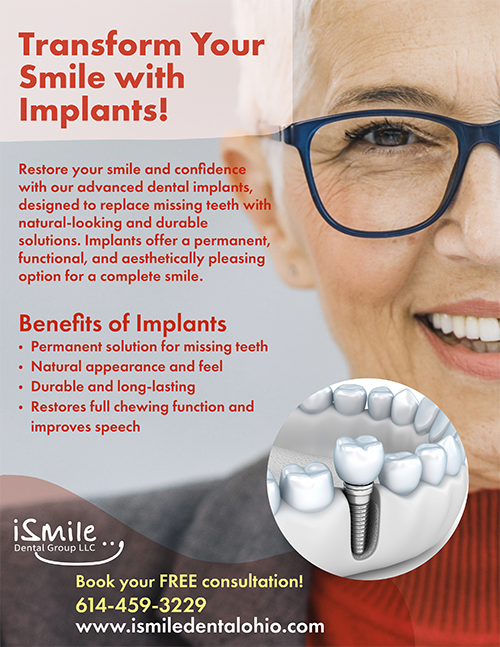
Most adults who are in generally good health and have adequate jawbone are candidates for implants. We assess each patient’s medical history, oral health, and daily habits to determine the best course of care. When bone volume is limited, techniques such as grafting can prepare the site to accept an implant, broadening the pool of potential candidates.
Implant placement is typically an outpatient procedure performed under local anesthesia, with sedation options available for patient comfort. After placement, a healing period allows the implant to integrate with the bone. Our team provides detailed pre- and post-operative instructions and will monitor healing to ensure predictable progress toward the final restoration.
Bone loss after tooth extraction or due to periodontal disease can limit the options for implant placement. Bone grafting rebuilds the foundation needed to support an implant and is a common, well-established procedure. When grafting is recommended, it’s part of a goal-oriented plan to create long-term stability for your new tooth or teeth.
After your implant restoration is in place, routine dental checkups and good oral hygiene are essential to maintain its health. Implants do not decay, but the tissues around them can be affected by gum disease if not properly cared for. With regular professional care and sensible daily habits, implants can remain a dependable part of your smile for many years.
Dental implants offer a versatile, clinically supported way to replace missing teeth while preserving oral health and restoring function. Whether you are considering a single implant, multiple implants, or a full-arch solution, our team approaches each case with careful planning and attention to detail. To learn more about implant dentistry and how it might help you, contact us for additional information. We’re happy to discuss your options and answer questions about the process.

1151 Bethel Rd Suite, #301
Columbus, OH 43220
Existing Patients: (614) 459-3229
New Patients: (614) 328-8033
If you've lost a tooth due to injury, decay, gum disease, or any other reason, we recommend dental implants to replace missing teeth. Dental implants come the closest to replicating the look, feel, and function of your natural teeth.
Dental implants are placed into the jawbone and mirror the same function as the root of a tooth. The procedure for dental implants is usually performed while a patient is sedated. Patients who undergo IV sedation must have an empty stomach and transportation home following the procedure. Most sedation patients will have little to no memory of the procedure occurring.
Generally, dental implants are made out of a biocompatible metal such as titanium. Biocompatible metals are also used for other common bone implants (such as shoulder, hip, and knee replacements). The visible portion of the implant is usually made out of porcelain and is custom-made to match your existing teeth.
Dental implants are designed to fuse to the bone, which makes them become permanent fixtures. Typically speaking, the success rate is nearly 100%. There are few cases in which the implant will not fuse as intended and must be removed. If this happens to occur, the procedure can be attempted again a few months later.
Dental implants are not usually covered by dental insurance, but may be covered under a patient's medical insurance. Our office and your insurance company can discuss coverage options with you based on your individual case and treatment plan.
It's easy... just take care of an implant as if it's a natural tooth! This involves regular brushing, flossing, and dental checkups. If you have any concerns about your implant, contact us immediately.