New Patients
Existing Patients
1151 Bethel Road, #301, Columbus, OH 43220
Call Today
5040 Palmetto St, Unit A, Columbus, OH 43228
New Patients
Existing Patients
Call Today

Your smile is an important part of how you present yourself to the world, and when a tooth is damaged or weakened, it can affect both comfort and confidence. Modern dental crowns are a reliable way to rebuild a tooth’s strength, restore chewing function, and recreate a natural appearance that blends with the rest of your smile. This page explains what crowns do, how they’re made, and what to expect so you can make an informed decision about your restorative care.
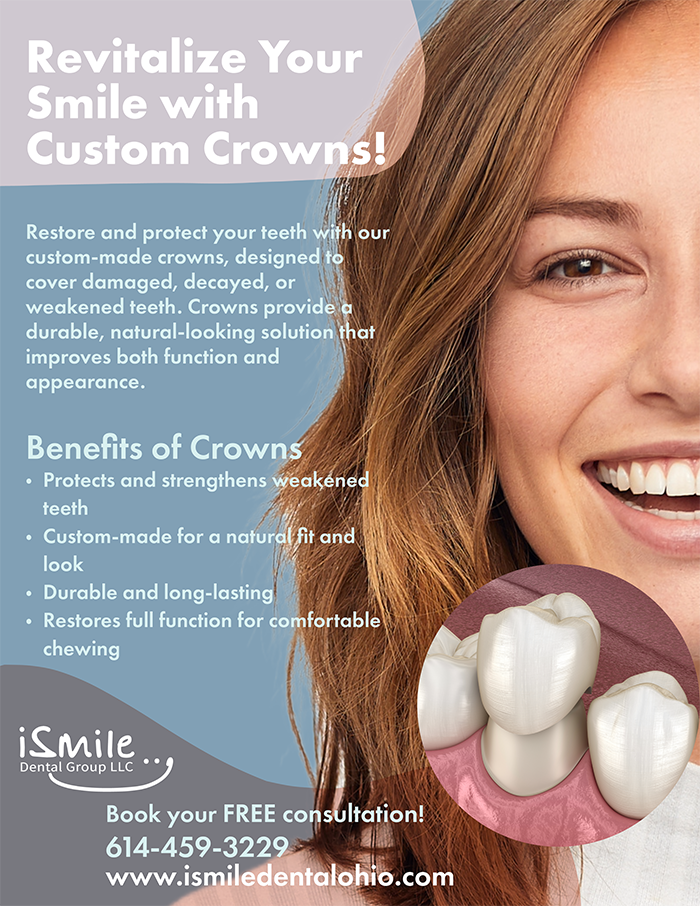
At iSmile Dental Group we focus on combining clinical precision with an aesthetic approach so that restorations are both durable and visually pleasing. Below you’ll find straightforward information about indications for crowns, the differences between materials, how the treatment process works, and practical advice for long-term care. Our goal is to help patients understand their options and feel confident about the path forward.
Small cavities and minor enamel loss are often treated with dental fillings, but there are situations where a filling isn’t enough. Extensive decay, large old fillings that fail, fractures that extend under the gum line, or a tooth weakened by a root canal are all circumstances in which a crown becomes the preferred restoration. A crown covers the entire visible portion of the tooth, distributing chewing forces and shielding what remains of the natural structure from further damage.
Decisions about whether to place a crown take into account how much healthy tooth remains, the tooth’s position in the mouth, and the type of stress it will face during chewing. Posterior (back) teeth typically require stronger materials because they handle more force, while front teeth often prioritize translucency and shape for a lifelike appearance. Your dentist will evaluate the tooth and suggest a solution that preserves function while addressing cosmetic concerns.
Crowns also play an important role beyond single-tooth repairs. They serve as anchors for fixed bridges, cap dental implants, and are sometimes used to reinforce teeth that show signs of significant wear from grinding or clenching. In each case, the crown’s job is to restore stability and protect surrounding teeth from further compromise.
Today’s crown materials range from high-strength ceramics to traditional porcelain fused to metal, and each option carries distinct advantages. All-ceramic crowns offer excellent esthetics because they mimic the way natural enamel transmits light, making them a strong choice for visible front teeth. Zirconia and other advanced ceramics deliver superior strength and durability for molars where bite forces are greater.
Porcelain-fused-to-metal (PFM) crowns combine the strength of a metal core with a porcelain outer layer for a balance of durability and appearance. While newer ceramics have reduced the need for metal-based crowns in many cases, PFMs remain a reliable option when extra support is needed for compromised tooth structure. Your dentist will weigh factors like visibility, bite dynamics, and the amount of remaining tooth to recommend the material that best fits your needs.
Biocompatibility and long-term wear are also considerations. Ceramic materials tend to be gentle on opposing teeth and resist staining, while certain high-strength ceramics can withstand heavy chewing forces without chipping. Understanding these trade-offs helps patients choose a restoration that meets both functional and cosmetic goals.
The crown procedure is designed to restore your tooth efficiently while minimizing discomfort. After a careful examination and any needed imaging, the tooth is prepared by removing damaged or decayed tissue and shaping the remaining structure to receive the crown. If a root canal or core buildup is needed first, that will be completed before moving forward so the tooth has a stable foundation.
Once the tooth is prepared, impressions or digital scans capture the exact contours of the mouth. Many practices now use CAD/CAM technology to design and mill crowns in-house, which can shorten treatment to a single appointment. When a lab-manufactured crown is preferred, a temporary restoration protects the tooth while technicians create the final piece to match the shape and shade of adjacent teeth.
At the final visit, the crown is tried in to confirm fit, bite, and esthetics before being permanently cemented. Your dentist will check the contacts with neighboring teeth and make small adjustments as needed so the restoration feels comfortable and functions naturally within your bite.
A crown does not eliminate the need for good oral hygiene. Brushing twice daily with a fluoride toothpaste, flossing around the crown margin, and attending regular professional cleanings are essential to prevent decay at the crown’s edges and to maintain gum health. Patients who grind or clench should discuss protective measures, such as night guards, to reduce stress on restorations and extend their lifespan.
Routine dental visits allow your clinician to monitor the condition of crowns and the surrounding tissues. Early detection of issues like recurrent decay, looseness, or gum inflammation makes repairs simpler and helps avoid more extensive treatment later. With consistent care, many crowns provide dependable service for many years.
If you notice sensitivity, a change in how a crown feels when you bite, or any looseness, contact the practice promptly so the problem can be evaluated. Timely attention often prevents further damage and preserves the health of the tooth beneath the crown.
Crowns frequently serve as a key component in comprehensive restorative dentistry. When replacing a missing tooth with an implant, a crown is the visible, functional element that completes the restoration. In bridgework, crowns anchor the prosthesis on adjacent teeth to close gaps and restore chewing efficiency. For full-mouth rehabilitation, crowns can be combined with other treatments to rebuild occlusion and improve overall oral health.
Choosing a crown is rarely an isolated decision; it is part of a tailored plan that considers bite alignment, opposing teeth, and long-term maintenance. Your dentist will coordinate the sequence of treatments to achieve predictable results, whether that involves preparatory tooth restorations, implant placement, or cosmetic refinements to ensure a harmonious outcome.
Open communication about expectations, lifestyle factors, and any esthetic priorities helps the team design a treatment path that balances longevity with appearance. When crowns are planned and placed thoughtfully, they become a durable, integrated part of a healthy, functional smile.
In summary, crowns are a versatile and proven solution for repairing and protecting teeth that are compromised by decay, fracture, wear, or restorative needs. They restore strength, function, and appearance while integrating into larger dental treatment plans when required. If you’d like to learn whether a crown is the right option for your tooth, please contact us for more information and to schedule a consultation with our team.

1151 Bethel Rd Suite, #301
Columbus, OH 43220
Existing Patients: (614) 459-3229
New Patients: (614) 328-8033